

Menzerna 300 vs 400: Which Heavy Cut Compound Is Better for Paint Correction?
Menzerna 300 vs 400: Which Heavy Cut Compound Is Better for Paint Correction?
A heavy cut compound can make a major difference when paint has visible scratches, sanding marks or heavy oxidation. But choosing the strongest compound is not always the right approach. The paint condition, machine, pad and finishing requirements all matter.
Two popular options are Menzerna Super Heavy Cut Compound 300 and Menzerna Heavy Cut Compound 400. Both are designed for correction work, although they offer different balances of cutting performance and finish. This guide explains the difference in practical terms, so you can select the right product without removing more clear coat than necessary.
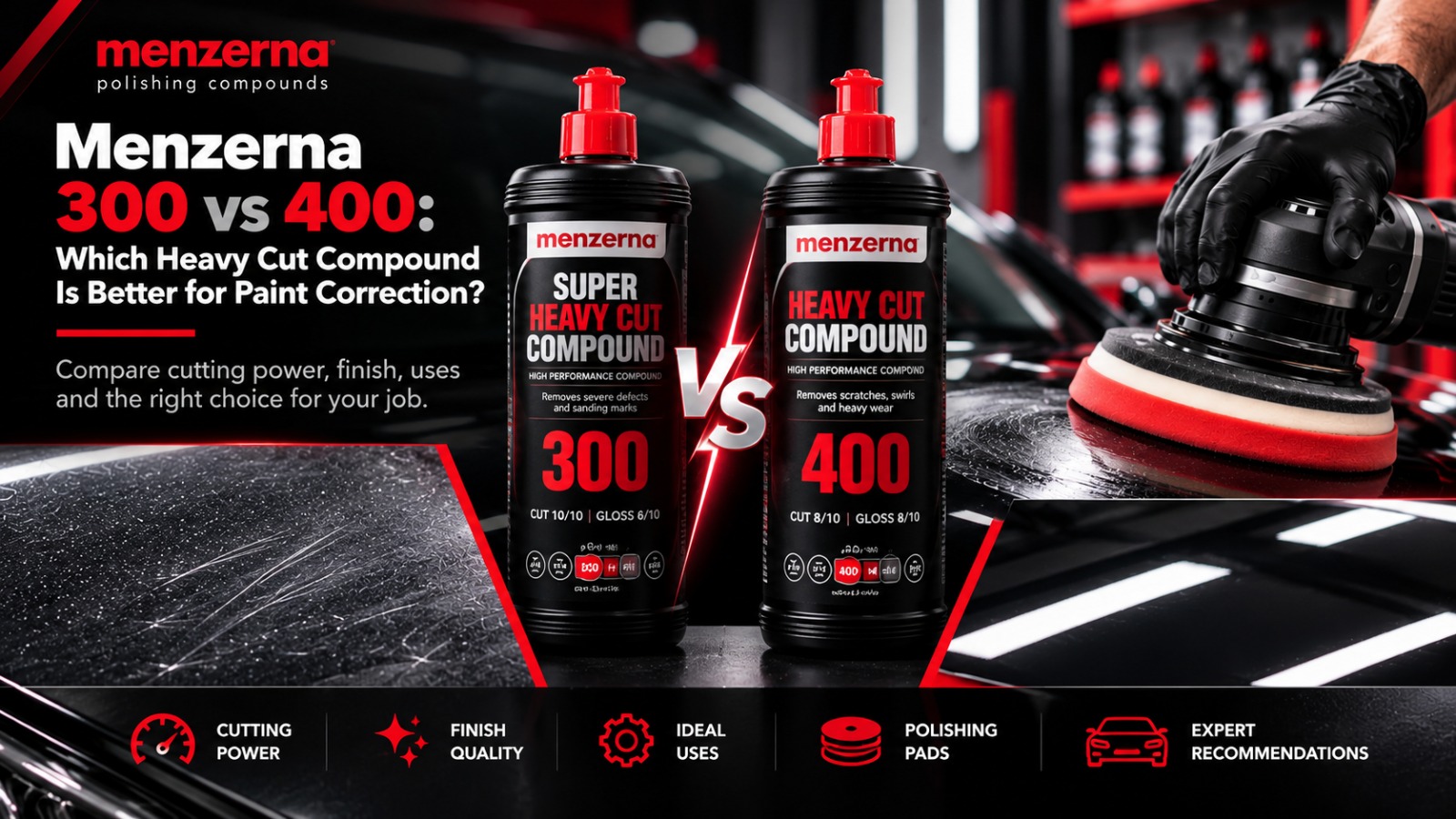
Menzerna 300 is the more aggressive option. Its published cut rating is 10/10, compared with 8/10 for Menzerna 400. Menzerna 400 has the higher published gloss rating: 8/10 versus 6/10 for Menzerna 300. Choose 300 for severe, correctable defects when a strong cut is required. Consider 400 for substantial correction where a cleaner finish is also a priority. Test a small area before deciding.
What Is Menzerna Super Heavy Cut Compound 300?
The Menzerna Super Heavy Cut Compound 300 is intended for demanding correction jobs. It is especially useful where sanding marks and serious surface defects need aggressive attention.
With a 10/10 cut rating, it is best regarded as a specialist correction compound rather than a routine gloss product. Its 6/10 gloss rating also signals that a refinement stage may be useful afterward. A body shop correcting paint after refinishing may have different requirements from a detailing studio preparing a regularly driven car.
The benefit of stronger cutting is that it can address difficult defects more effectively in the correct circumstances. The trade-off is that it can remove paint material more quickly, which makes paint assessment important.
What Is Menzerna Heavy Cut Compound 400?
The Menzerna Heavy Cut Compound 400 combines a strong cut rating of 8/10 with an 8/10 gloss rating. It is designed for noticeable paint defects while aiming for a relatively refined result after the cutting stage.
For a detailing job with heavy swirls, moderate scratches or visible dullness, this balance can be useful. On certain paint finishes, it may reduce the amount of follow-up polishing needed. That does not mean it always produces a final, ready-to-protect finish: softer or sensitive paints may still show haze or fine machine marks.
Menzerna 300 vs 400 Comparison Table
|
Feature |
Menzerna 300 |
Menzerna 400 |
|
Product class |
Super heavy cut compound |
Heavy cut compound |
|
Cut rating |
10/10 |
8/10 |
|
Gloss rating |
6/10 |
8/10 |
|
Main strength |
Aggressive correction |
Cut and finish balance |
|
Typical use |
Severe correctable defects; sanding marks |
Swirls, scratches and heavy wear |
|
Follow-up polishing |
Often useful |
Depends on final finish |
|
Machine choice |
Suitable rotary or DA setup |
Suitable rotary or DA setup |
These ratings are relative product ratings, not guaranteed results. Paint hardness, pad type, machine movement and technique can change the outcome.
Which One Works Better for Scratches?
A compound can only correct defects within the polishable paint layer. Some visible scratches are shallow enough to improve with polishing; others extend too far into the coating and need a different repair method. Neither Menzerna 300 nor 400 can rebuild missing clear coat or colour.
Choose Menzerna 300 for severe correctable defects
Menzerna 300 makes sense when a test area shows that a less aggressive combination is not sufficient, and an experienced professional has confirmed that the paint can safely tolerate stronger correction. That may include substantial sanding marks after paint repair or difficult defects on harder clear coats.
Choose Menzerna 400 for strong correction with refinement
Menzerna 400 is often a better first heavy-cut candidate when the surface has significant swirls or scratches but does not clearly require maximum cutting power. Its higher gloss rating makes it a practical option for jobs where the finish after the first correction pass matters.
For light defects, reconsider both
If the car has only faint wash marks or light haze, a medium or fine polish may be enough. Starting with the least aggressive effective combination helps preserve the surface and avoids unnecessary work.
How Polishing Pads Change the Result
A compound never works in isolation. The pad controls contact with the paint and affects both defect removal and finish quality. A firm cutting foam pad can deliver strong correction, while a suitable wool pad may increase aggression on demanding jobs. Those same choices can influence the amount of refinement needed later.
Menzerna India lists a Premium Heavy Cut Foam Pad Red 6 Inch for heavy cutting applications. Pad selection should still be checked against the polisher, backing plate and paint condition.
Keep the pad clean throughout the job. A saturated or dirty pad can cut inconsistently and leave unwanted marks. Replace or clean pads as the work progresses, and inspect the surface before deciding whether stronger correction is necessary.
Should You Polish Again After Heavy Cutting?
Often, yes. After an aggressive correction stage, the paint may look much better while still carrying a light haze or machine marks under direct inspection light. A separate medium or finishing stage can help improve clarity.
For intermediate refinement, consider Menzerna Medium Cut Polish 2400. It is positioned for medium defects and for refining a surface after heavier correction.
For final refinement, Menzerna Super Finish Plus 3800 is intended for fine polishing and gloss improvement. Its role is different from a heavy cut compound: it focuses on final clarity rather than removing severe defects.
Not every surface needs every step. The most appropriate sequence is the one that produces an acceptable finish without excessive paint removal.
Practical Paint Correction Checklist
● Inspect the paint under good lighting and identify the actual defects.
● Assess whether the surface has enough coating for correction; use professional measurement and judgement where needed.
● Start with a less aggressive test combination and evaluate the outcome.
● Choose the pad and compound together rather than comparing compounds alone.
● Keep pads clean, avoid unnecessary repeated passes and inspect the finish.
● Refine with a medium or finishing polish if haze or fine marks remain.
● Apply suitable protection only after the correction and cleaning stages are complete.
Mistakes to Avoid
Assuming stronger always means better
Menzerna 300 has a higher cut rating, but that does not make it the right choice for every car. Unnecessary aggression reduces the margin for future correction.
Treating every scratch as removable
Some scratches extend deeper than the clear coat. A compound may soften their appearance without removing them completely. Chasing full removal can create avoidable damage.
Judging the finish in poor lighting
A surface can appear glossy under workshop light yet still show haze under direct sunlight or focused inspection lighting. Examine the finish carefully before stopping.
Skipping the test spot
A small trial area tells you more about the specific car than a general recommendation. Clear coats vary in hardness and sensitivity, even between cars of the same colour.
Which Compound Should You Buy?
Choose Menzerna 300 if the job involves severe, polishable defects and a professional assessment supports aggressive cutting. Choose Menzerna 400 if you need substantial correction with more emphasis on the quality of the finish left behind. For routine light defects, consider a less aggressive polish before either heavy cut option.
For a studio handling different vehicles, the most useful approach is not to pick one product for every car. Keep the correction process flexible, inspect each panel and select the minimum effective cut.
Frequently Asked Questions
Is Menzerna 300 stronger than Menzerna 400?
Yes. Menzerna assigns 300 a cut rating of 10/10 and 400 a cut rating of 8/10. That describes their relative cutting performance, not a fixed amount of paint removed.
Which compound gives better gloss?
Menzerna 400 has the higher published gloss rating, 8/10 versus 6/10 for 300. The actual finish still depends on the paint, pad, machine and working method.
Can Menzerna 400 remove deep scratches?
It may reduce or remove scratches that remain within the safely correctable paint layer. Scratches that penetrate too deeply cannot be repaired by compounding alone.
Do I need a finishing polish after Menzerna 300?
Often a refinement step is helpful because the more aggressive cut may leave some haze or fine marks. Inspect the finish and decide based on the result.
Can these compounds be used with a dual-action polisher?
Both are used in compatible machine-polishing setups, including rotary and dual-action systems. Match the compound and pad to the equipment and surface.
Which one is better for a professional detailing studio?
Both have a place. Menzerna 300 is suited to demanding correction, while Menzerna 400 offers a useful balance of correction and finish for many heavy-cut jobs.
Final Verdict
Menzerna 300 vs 400 is not a question of which bottle is universally better. Menzerna 300 is the specialist choice when maximum cutting power is justified. Menzerna 400 is a balanced heavy cut option when strong correction and a cleaner finish both matter. The best result comes from assessing the paint, testing an appropriate combination and polishing only as much as needed.


No comments yet. Be the first to comment!