
Why Car Polish Leaves Holograms and How to Prevent Them
Why Car Polish Leaves Holograms and How to Prevent Them
You spend a whole Sunday polishing your car. In the garage, the paint looks perfect. Then you roll it out into the sun, and you see faint, curved, shiny lines floating across the paint.
These are car polishing holograms, and almost every detailer has met them at least once. They are annoying, but they do not mean you ruined your paint. They only mean one small part of your method needs a change.
In this guide, we explain why polish leaves holograms, how to remove them, and how to stop them from coming back. Everything is written in simple words, based on common professional detailing practice and the polishing system used by Menzerna.
What Are Car Polishing Holograms?
Hologram marks on car paint are tiny scratches in a swirling pattern. One scratch alone is too small to see. But together, they bounce light in circles, and that is what creates the shimmer. Many people also call them buffer trails on car paint, because the marks follow the path of the buffing pad.
You will mostly see them in direct sunlight or under a strong LED torch. In the shade, the paint can look perfect. That is why many people only notice them after the car is parked outside.
Think about sanding a piece of wood. If you stop at rough sandpaper, you can still see the lines. You need to move to a finer grit to get a smooth surface. Polishing works the same way. A heavy compound cuts the paint, and a finishing polish smooths out what the compound left behind.
Why Does Car Polish Leave Holograms?
Car polishing holograms nearly always come from a small set of mistakes. The good news is that each one is easy to fix.
1. Using a rotary polisher without enough practice
Rotary polisher holograms are the most common kind. A rotary machine spins in one fixed circle. It cuts fast and creates more heat. That is great for deep scratches, but with an aggressive pad and high speed, it leaves a clear circular pattern. A dual action polisher for car use moves in a wobbling, random motion, so it rarely leaves these trails.
2. Stopping at the compound stage
A car polishing compound is made to cut. It removes scratches by replacing them with much finer ones. If you stop there, those fine scratches stay on the paint. A car finishing polish is the step that removes them. Skipping it is one of the biggest car polishing mistakes.
3. Wrong pad choice
Car polishing pad selection matters more than most people think. Wool and firm foam pads cut deep. If you use them and do not follow up with a soft pad, you get holograms. The pad and the polish must match the stage of work.
4. Too much pressure or too much speed
Pressing hard does not make polish work better. It only pushes the abrasives deeper and creates uneven marks. High speed adds heat, and hot paint is easy to scratch.
5. Dry polish and dirty pads
If the polish dries out on the paint, or the pad is full of old residue and dust, it can scratch instead of smooth. Clean your pad often.
6. Holding the machine at an angle
When the pad is tilted, only one edge touches the paint. That edge cuts harder and leaves lines. Keep the pad flat on the panel.
How to Check for Holograms Before You Finish
Do not trust garage lights alone. Here is a simple way to check:
- Wipe the panel with a 50:50 mix of isopropyl alcohol (IPA) and water. This removes polish oils that can hide marks.
- Look at the paint in direct sunlight, or use an LED swirl finder torch.
- View the panel from different angles. Holograms often appear and disappear as you move.
This quick check helps you spot car polishing holograms early, before you apply any wax or sealant.
How to Remove Holograms from Car Paint
Car polish hologram removal is simple when you follow the right order. Here is how to remove car polishing holograms step by step:
- Wash and decontaminate. Dirt left on the paint will scratch it again. Wash the car and use a clay bar if needed.
- Tape sensitive areas. Cover plastic trims and rubber edges.
- Do a test spot. Try your pad and polish on a small 2x2 feet area first.
- Switch to a soft pad. A soft cut foam pad is gentle and removes light marks without adding new ones.
- Use a fine finishing polish. Menzerna Super Finish Plus 3800 is made to remove micro-scratches and holograms and leave a deep, mirror-like gloss.
- Keep your speed low. With a dual action machine, use a medium speed. With a rotary, stay around 1,000 to 1,200 RPM.
- Move slowly. Use light pressure and slow, overlapping passes. Two or three passes are usually enough.
- Wipe and inspect. Use IPA again and check in sunlight. If marks remain, repeat once.
- Protect the paint. Finish with a wax or sealant to lock in the shine.
If the marks are deeper than holograms, they may be real scratches. In that case, you may need a medium polish first, then the finishing step.
How to Prevent Car Polishing Holograms
Prevention is easier than correction. Keep this checklist handy:
- Follow a step-by-step process. Cut first, refine next, finish last. This is the heart of proper car paint correction. You can see the full method in the 4-step polishing program.
- Match the pad to the polish. Use a cutting pad only with a cutting compound, and a soft pad for finishing.
- Use the right machine. A dual action polisher is much safer for beginners.
- Keep the pad clean. Brush it or wipe it after every panel.
- Work in small sections. About 2x2 feet at a time gives you control.
- Do not skip the final step. A finishing polish is what keeps your paint hologram free.
- Check often. Wipe and inspect after each section, not just at the end.
A Simple Four-Step Menzerna System
The easiest way to avoid car polishing holograms is to use a system where each product has one job. Here is how it works:
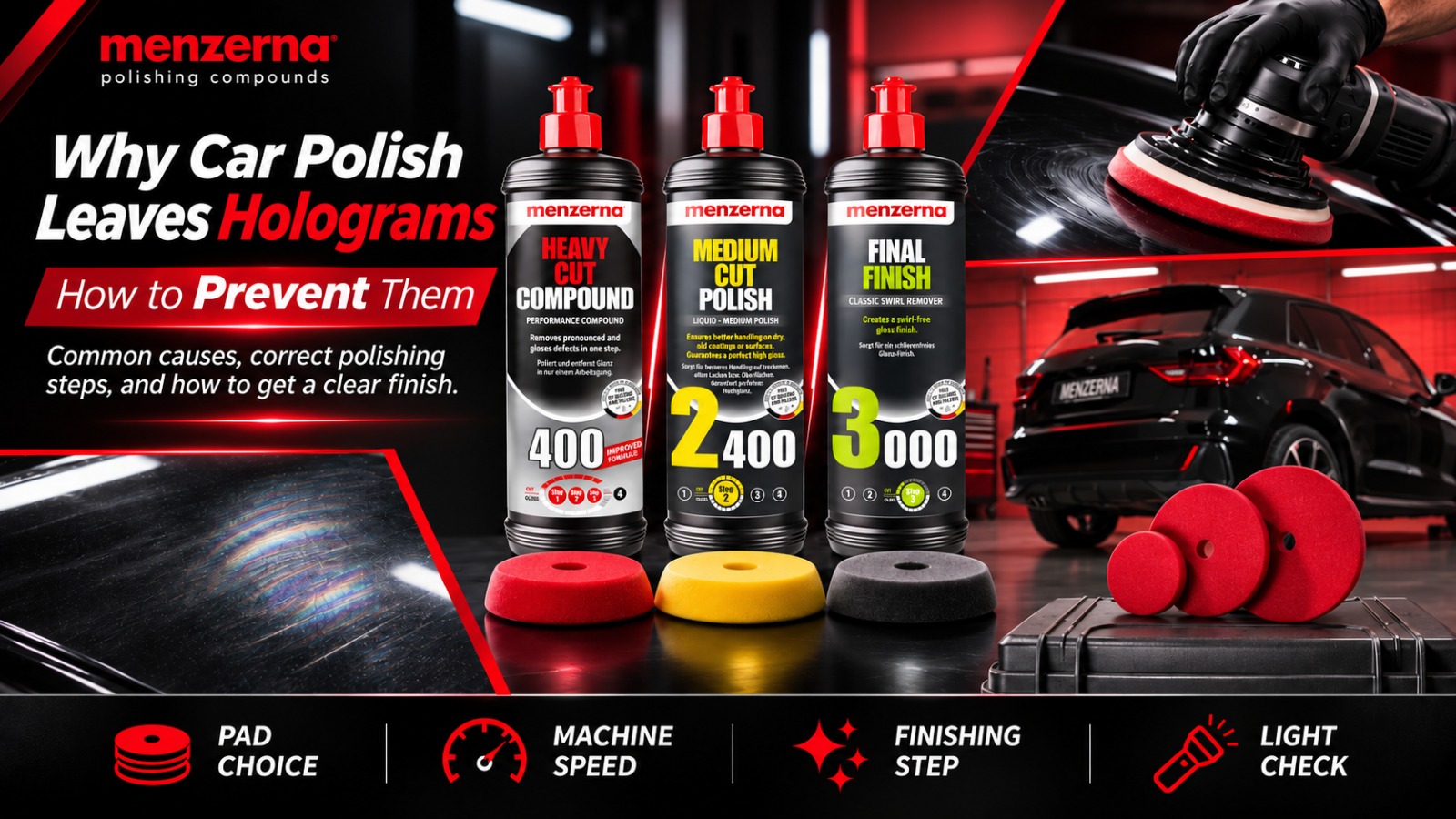
- Step 1: Heavy Cut. Use Heavy Cut Compound 400 to remove deep scratches and sanding marks quickly.
- Step 2: Medium Cut. Use Medium Cut Polish 2400 to remove swirls and moderate wear. It works smoothly even on older, dry paint or very soft coats.
- Step 3: Finish. Use Final Finish 3000 with a soft pad to clear the last light swirls and hairline scratches.
- Step 4: Protection. Seal the paint with a wax or sealant so the shine lasts and water beads off.
Do not forget the right pads. Menzerna car polishing foam pads come in red (heavy cut), yellow (medium cut), and green (soft cut), in 6 inch and 7 inch sizes. Match each step with the correct colour.
Always follow the directions on the product label, and test on a small area first. Every paint is different.
Which Is Better for Avoiding Holograms - Rotary vs Dual Action?
|
Rotary Polisher |
Dual Action Polisher |
|
|
Cutting speed |
Very fast |
Moderate |
|
Risk of holograms |
Higher if used wrongly |
Low |
|
Best for |
Experienced users, heavy defects |
Beginners and finishing work |
|
Heat build-up |
High |
Low |
If you are new to polishing, start with a dual action machine. If you use a rotary, always finish with a soft pad and a fine polish, or the machine can leave car polishing holograms behind.
Common Car Polishing Mistakes to Avoid
- Using one product and one pad for the whole job
- Polishing in direct sun or on hot paint
- Using too much polish, which gums up the pad
- Pressing too hard
- Not checking the paint in proper light
- Skipping the clean-up between steps
Frequently Asked Questions
Why does my car have holograms after polishing?
It usually means the last step was too aggressive. A heavy compound or hard pad leaves fine scratches, and without a finishing polish those scratches show as holograms.
Are car polishing holograms permanent?
No. They are very shallow marks in the clear coat. A fine polish with a soft pad can remove them.
Can I remove holograms by hand?
Light marks can be reduced by hand, but it is slow and the results are uneven. A dual action polisher gives a better finish.
Do car polishing holograms damage the paint?
They do not harm the paint, but they make it look dull and uneven. They are a finish problem, not a structural one.
What is the best way to avoid holograms?
Use the right pad for each stage, keep speed and pressure low, and always finish with a fine polish.
Final Thoughts
Car polishing holograms look scary, but they are simple to understand. They come from deep cutting without proper refining. Once you follow the cut, refine, and finish steps, choose the right pads, and check your work in good light, the problem goes away.
Take your time, test first, and trust the process. Your paint will reward you with a clean, deep, hologram free shine.
Have a question about the right polish or pad for your car? Call Menzerna India on +91 82-52-300-400 or write to info@menzernaindia.com.


No comments yet. Be the first to comment!